
Salt'N'Pepa
(L to R: Sandra "Pepa" Denton, Deirdre "Spinderella" Roper, Cheryl "Salt" James)
This hip-hop duo (which would eventually also include their DJ, Spinderella to form a trio) first stormed the charts in 1987 with the now classic dance club anthem, “Push It”. A consistent staple during the New Jack Era, they continued to rule the female rap game with songs like “Expression”, “Let’s Talk About Sex”, and “Independent”.
By 1994, the New Jack Era had been over for two years, but Salt’N’Pepa came back stronger than ever with a sexy new look. With songs like “Shoop”, “Whatta Man”, and “None Of Your Business”, Salt’N’Pepa were on top in that year, and even performed at Woodstock II that summer. In 1996, they released a final album that was a commercial disappointment. As a group, they haven’t been heard from again, but as personalities they are heard from every now and then.
Schooly D
...bio coming soon!
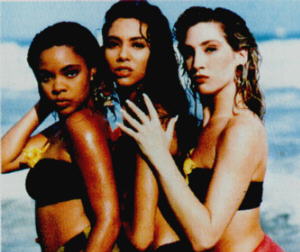
Seduction
(L to R: April Harris, Idalis (De)Leon, & Michelle Visage)
Produced by the late David Cole and Robert Cliviles (better know as the C&C Music Factory), this act scored four hits circa 1990: “You’re My One And Only (True Love)”, “Two To Make It Right”, “Could This Be Love”, and “Heartbeat”. For some reason, the group never released a follow-up. However, Idalis Leon went on to become an MTV VJ in the mid-1990s, and Michelle Visage sang lead vocals on “It's Gonna Be A Lovely Day” from 1992’s ‘The Bodyguard: Soundtrack’ as part of the S.O.U.L. S.Y.S.T.E.M.
Additionally, Michelle Visage who was on the 103.5 WKTU-FM morning show in NYC is now at Hot 92.3 in Los Angeles co-hosting with Sinbad on his morning show.
Shabba Ranks
...bio coming soon!

Shanice (Wilson)
Shanice graced pop/R&B albums such as New Edition’s “Under The Blue Moon” as the Silent Soldier. An upbeat and peppy woman, Shanice flourished near the end of the New Jack Era in the summer/fall of 1991 with “I Love Your Smile”. She continued to score with hits like “Silent Prayer”, and in 1994 with a single entitled “It’s For You” from the Meteor Man soundtrack. In late 1994, she released “Turn Down The Lights”, a song that is now a minor classic. In 1999, Shanice staged a comback that performed moderately well. The most notable aspect of Shanice (besides her strikingly cute face) is her amazingly dexterous voice.
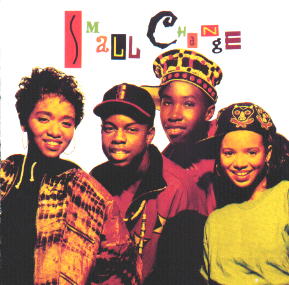
Small Change
Circa 1991 -- on the heels of Janet Jackson's eighth single from 'Rhythm Nation 1814' ("State Of The World") -- came a quartet of preeteens named Small Change. "Why?" (the group's first single) was a pro-social new jack uptempo that dealt with themes like child abuse, world hunger, drugs, etc. The rest of the album's nine tracks were solid as well, with highlights including "Teardrops", the Babyface-esque "Sneakin", "This Must Be Love", and the blessedly poignant ballad, "She May Be Pretty".
If this album had been released a year earlier, it probably would have achieved more commercial success than it did. To get a "feel" for the sound of this co-ed group, imagine Tracie Spencer or Tyler Collins on a duet with the Boys.
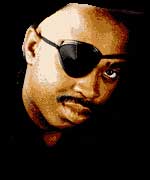
Slick Rick
Born in London to Jamaican parents in 1965, Ricky Walters emigrated with his family to the Bronx in the late 70s where he got a chance to hone his musical skills at the famous La Guardia High School of Music & Art, where he met fellow New Jack Era rapper Dana Dane. The trademark eyepatch that Ricky wore was for real...he was blinded by broken glass as an infant.
Ricky and Dana Dane hooked up to form the Kangol Crew, and participated in MC battles around NYC when Rick (now called MC Ricky D) met up with Doug E. Fresh and the Get Fresh Crew. This event led to 1985's mega-single "The Show", featuring the B-side "La Di Da Di". These two recordings will probably remain hip-hop classics for as long as hip-hop lives.
Soon enough, MC Ricky D morphed into the jewelry-wearing, smooth voiced (but oh, so misogynistic) Slick Rick, dropping his debut (and impressive) record 'The Adventures Of Slick Rick' in 1988 on Def Jam Records. The album featured "Mona Lisa", "Children's Story", "Hey Young World", "Teenage Love", and the underground smash, "Treat Her Like A Prostitute". The buzz surrounding Slick Rick around that time was intense, and he gained even more exposure with the R&B crowd after joining Al B. Sure! for the hit "If I'm Not Your Lover".
Unfortunately, Slick Rick ran into trouble with the law and was convicted of attempted murder after an altarcation with his cousin (who had allegedly been harrassing his mother). Eventually he would serve a five year prison term but not before recording 1991's 'The Ruler's Back' while out on bail for three weeks, thanks to Russell Simmons. Unfortunately, 'Ruler' didn't do nearly as well as 'Adventures' had.
Throughout the 90s, Slick Rick has been regarded as a legend in hip-hop history despite his legal and personal tribulations. In 1994 he released the album "Behind Bars" while he was in the very position the album title describes; it wasn't received very well. But that didn't matter too much - Slick Rick had just gotten props from Snoop Doggy Dogg (who was the *hottest* thing out in 1993) a year earlier when he reprised "Lodi Dodi" for his 'Doggystyle' album out of sheer respect.
By the time Slick Rick released 'Da Art Of Storytelling' in 1999, he was a free man with the moderate hit, "Street Talking". But perhaps like his labelmates Public Enemy, Slick Rick has nothing more to prove...his legacy in hip-hop was immortalized the day he joined Doug E. Fresh and produced "The Show" and "La Di Da Di" in 1985.
Editor's Note: Def Jam Records has started an online petition to help Slick Rick in light of his most recent legal problems. You can check it out here
For a full background of Slick Rick's latest situation, you can read the MTV News article here
Snap
Striking it big with an irresistible anthem called “The Power”, this Germany-based techno/hip-hop group stormed onto the music scene in 1990. By 1991, they had recorded “Go For It” for the Rocky V soundtrack. In the meantime, jams like “Oops Up” and “Mary Had A Little Boy” kept the clubs rocking, to the protest of rapper Chill Rob G, who claimed that the famous “Power” beat had been stolen from him – Rob G released his own version simultaneously.
In 1992, Snap released “Rhythm Is A Dancer”, their last hurrah. By 1993, Snap was never heard from again.
Soul II Soul
Soul II Soul was a UK based R&B/Dance act that added an air of elegance and sophistication to Black music during the New Jack Era. The founding members of Soul II Soul included leader Jazzie B, producer Nellee Hooper, and instrumentalist Phillip Harvey. Soul II Soul also featured a collection of vocalists, most notably Caron Wheeler, who’s plush vocals were responsible for Soul II Soul’s biggest hits, “Keep On Movin” and “Back To Life”.
Soul II Soul was discovered after they became regular performers at a London club called the Africa Centre; they were subsequently signed to 10 records, a subsidiary of Virgin. Internationally, Soul II Soul’s debut album was called ‘Club Classics: Vol.1’, but in the US it was known as ‘Keep On Movin’. By award show season in 1990, Soul II Soul were industry favorites.
The summer of 1990 introduced Soul II Soul’s follow-up, ‘Volume 2: A New Decade’, which featured a new lead vocalist, and their last big single, “Get A Life”. By the end of 1992, Soul II Soul had faded into relative obscurity on American pop charts. Producer Nellee Hooper went on to become influential in the careers of UK acts such as Massive Attack, Bjork, and even provided U2 with their hit from 1995’s ‘Batman Forever: soundtrack’ -- “Hold Me, Thrill Me, Kiss Me, Kill Me”.
Soul II Soul was an extremely creative force during the New Jack Era, and undoubtedly influenced future R&B/Soul acts like Vertical Hold and Groove Theory from the mid 1990s…
Special Generation
These five guys were a creation of Stanley Burrell, better known as M.C. Hammer. Originally featured as vocalists on Hammer’s hits “Have You Seen Her”, and “Help The Children” in early 1990, Special Generation emerged with their own album in late 1990 with “Love Me Just For Me”. The lead vocal on that song was very much patterned off of Ralph Tresvant of New Edition.
In 1993, Special Generation returned with an album entitled “Butterflies”, with substantial production by Steve of Troop. One notable song, “You Can Tie Me Down” should have been a hit, but the song, the album, and the group faded into obscurity by the time 1993 was over.
Special Ed
...bio coming soon!